Trust Is a Decision, Not a Declaration

Why agent standards should make evidence interoperable without standardizing the verdict
A new trust boundary
At the API layer, trusting a remote caller has mostly come down to two questions: does it hold valid credentials, and is it authorized to make this call? Keys, OAuth scopes and signed requests handle that well for interactions that are short, clearly scoped, and initiated by a party that already has a relationship with the service and MCP tool authorizations extend the same model to an agent’s tool calls.
Agents stretch the interaction. An agent may run for hours, delegate to other agents that then act on its behalf, and so on the behalf of whoever delegated to it, call services its operator never listed, negotiate with agents run by other organizations, and produce effects in systems that belong to nobody in the original conversation. Along the way, three roles that used to sit inside one organization come apart: the party whose agent produced an action, the party that observed its effect, and the party that has to decide whether to rely on the result.
Inside one organization, internal logs are often a reasonable basis for that decision. Across organizations those logs are still evidence, but evidence the other party usually cannot check for itself. That is the new boundary. Credentials already cross it. Evidence about what happened mostly does not.
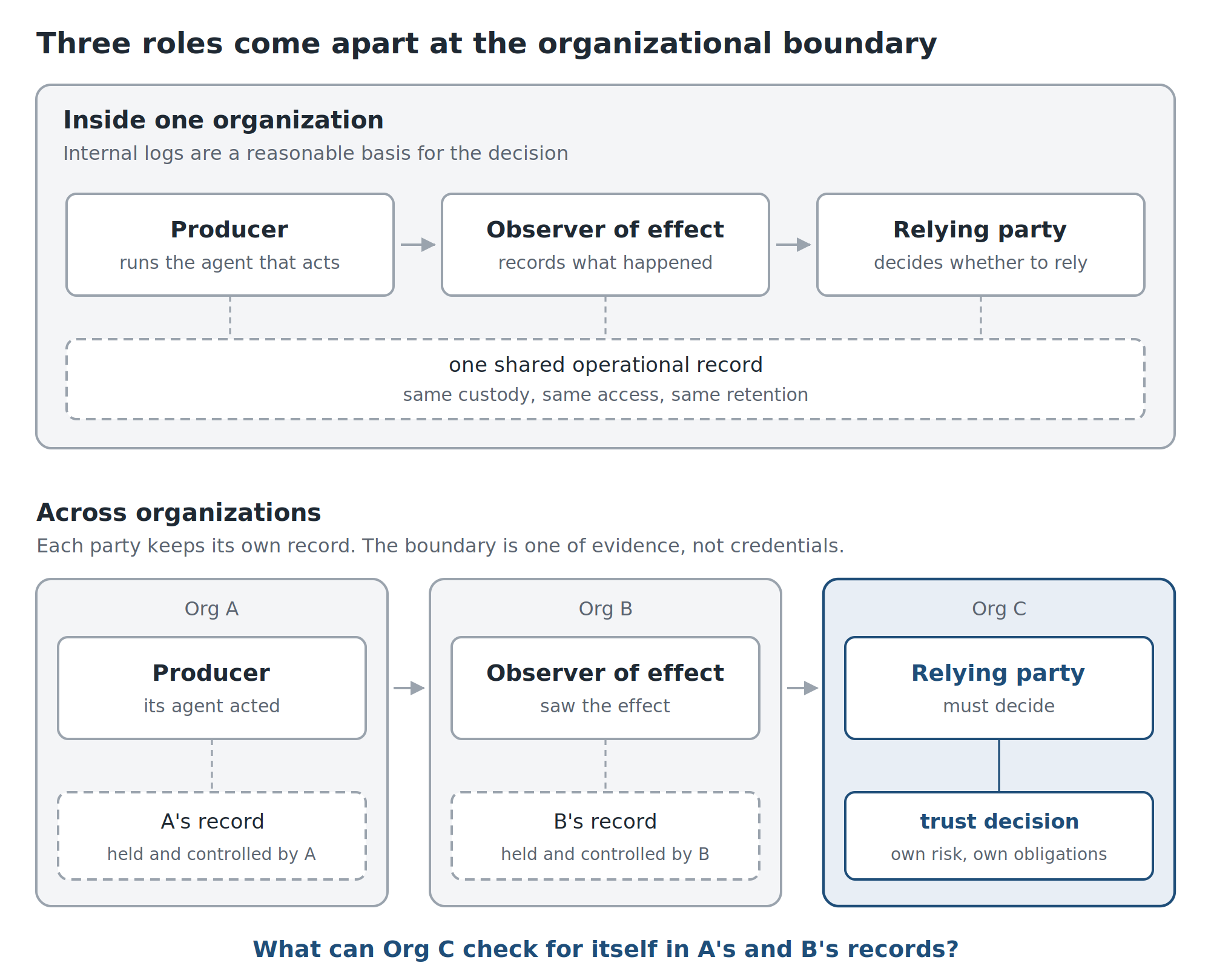
Figure 1. Inside one organization, the producer, the observer of the effect and the relying party share one record. Across organizations each keeps its own, and the relying party must decide from records it does not hold.
Call the party on the receiving side the relying party. It might be another agent or its operator, a service deciding whether to fulfill a request, a customer deciding whether to accept a result, an evaluator, a regulator, or a participant in a payment flow. A counterparty in a transaction is one important kind of relying party, but the pattern is broader than commerce. Wherever one party has to decide whether to act on what another party's agent did, there is a relying party and a trust decision.
Trust is not one question
Much of the confusion in discussions of agent trust comes from treating it as a single property an agent has or lacks. Four separate questions are hiding inside it, and a fifth question that is not evidence at all.
WHO is acting, and who stands behind it? This is identity and accountability: which agent, operated by whom, running what, on whose infrastructure, and which named person or quorum authorized this particular action. Keys, certificates and attestations answer the first half; binding a person to the exact action by its digest answers the second, so that an authorization cannot be replayed against a different action. Most protocol work on agent trust starts here for good reason.
What CAN it do? This is authority: what mandate the agent carries, who granted it, through what chain of delegation, with what limits, and what the policy decided before the action ran. Identity says nothing about whether this purchase, this data access or this handoff was authorized. A refusal is evidence too: "we said no, under this policy" should be as recordable as a yes, including each on-behalf-of hop, so that a relying party can see not only that a sub-agent was authorized but by whom, down the chain.
What was AUDITable? This is the substrate: the signatures, the canonical form and the neutral log that let a party who trusts none of the others confirm that the three records above are the records that were made, when they existed, and that both sides of a handoff asserted the same thing. It is evidence about the evidence, and it is the part most often left to whichever vendor happens to hold the logs.
What does that mean for me? This is the trust conclusion. It is not a fact about the agent and it is not evidence. It is a decision the relying party makes from whatever evidence about the first four it can obtain, filtered through its own risk, obligations and context.
Figure 2. Trust is four evidence questions and one decision. The first four travel as evidence; the decision stays with the party that lives with the result. In the agent accountability composition draft these are the WHO, CAN, WHAT and AUDIT legs, joined by one digest of the action.
The five are worth keeping apart because each fails differently. A well-identified agent can act outside its authority. An authorized agent can fail to do the thing it was authorized to do. A record that a request was sent is not a record that it took effect. A record with no neutral anchor can be rewritten and nobody can say when. A relying party with firm answers on identity and authority and nothing on behavior has less than it may think it has, and it should be able to see that.
What travels today: conclusions
When an agent needs to be trusted across an organizational boundary, the mechanisms available mostly carry a conclusion without its basis. A vendor attests to good practice. A certification records that a system passed a review at some point. A reputation score summarizes how other parties felt about past interactions. Operational logs can be produced on request.
All of these are useful and none should be discarded. But each asks the relying party to accept something it cannot examine. A reputation score is a summary of conclusions other parties reached under their own criteria. A certification speaks to a review, at a time, against a rubric, not to the interaction in front of you. Logs, however honestly kept, arrive without any way for the recipient to tell whether they are complete relative to what was recorded, unchanged since, or sufficient for this decision.
The alternative is for the basis to travel. An agent or its operator should not have to persuade every party it meets to accept a "trustworthy" label. It should be able to present material another party can examine for itself: who acted, under what authority, what was observed, and how to check that the material is the same material that was recorded. What the relying party concludes from it is its own business.
What should travel: four properties
If evidence is going to cross boundaries, it needs four properties. These are stated as things a relying party must be able to do, not as mechanisms.
Attributable. A relying party can tell who recorded an observation and in what role: the actor, its operator, the service that received the request, an independent observer. An unattributed observation can still be evidence. Attribution determines how much weight it can bear and what the observer was positioned to see. For agents that advertise themselves through a published card or manifest, attribution should also say which advertised capability the action used, cited so the card as published can be checked against the card as relied on.
Independently verifiable. A party other than the author can check that the record it received is the record that was made, and has not been altered since. This is a property of the record, not a statement about the world; an intact record can still be wrong. When a record was made is a separate question, and a signature alone does not settle it.
Portable. Evidence can leave the environment that produced it and still be checked. A relying party in one ecosystem can read and verify evidence from another without adopting that ecosystem's tools, accounts or trust policy.
Selectively disclosable. In real cross-organization interactions, neither side will reveal its complete execution history, and neither should be expected to. A full trace may contain other customers' data, internal reasoning or proprietary methods. A party must be able to disclose part of what it holds while the disclosed part stays attributable and verifiable on its own.
The fourth property has a hidden requirement that needs its own section.
Disclosure should keep the shape of the evidence
Selective disclosure solves a real problem and creates a subtle one. If a relying party receives a subset of what exists, how does it know what it is not seeing? Without an answer, selective disclosure is indistinguishable from selective omission.
A useful disclosure model lets a relying party see, for any disclosure, what it refers to (which interaction, which observer, what kind of evidence, how it can be checked), what was provided, and what was not: which categories exist but were withheld, which were unavailable, and where appropriate under what policy. The relying party does not need the withheld content. It needs to know the boundary is there.
Figure 3. Selective disclosure should keep the shape of the evidence. Provided, withheld, unavailable and absent lead to different next questions; the default keeps them distinct, with hiding a category's existence as an explicit choice for the cases where existence itself is sensitive.
This matters because "this was withheld" and "no such evidence existed" lead to very different decisions, and a disclosure that collapses them forces the relying party to guess. The default should be that the shape of the evidence survives disclosure even when the content does not.
There will be exceptions. Sometimes the existence of a category of evidence is itself sensitive, and saying "something was withheld here" leaks information. A standard should accommodate that as an explicit choice the disclosing party makes, rather than as the ambiguous default.
A light example. The simplest way to keep the shape is for the disclosing party to send, with whatever it discloses, a short signed inventory: the list of evidence categories that could exist for this interaction, and for each one a single word. For an agent that fulfilled an order it might read: mandate presented, provided; request received, provided; action taken, provided; delivery handoff, unavailable (retention expired); internal reasoning, withheld (policy: trade secret); other customers' data, withheld (policy: privacy); human approval, absent. Seven lines, signed by the party that holds the evidence, and the relying party can now ask the right next question. "Absent" on human approval means none was ever recorded, which may or may not be a problem under this relying party's rules. "Unavailable" on the handoff means something was observed and the record is gone, which is a different problem. "Withheld" names a policy that can be challenged. None of the content left the disclosing party, and the recipient still knows the boundary is there. An inventory like this is not a trust score and does not prove itself honest; it makes the inventory a signed claim that the other side's own inventory, or a later dispute, can be held against.
As bytes, in the shape Sam Sharaf proposed when reviewing this piece:
{
"interaction": "1f6f40b6…f073",
"evidence_manifest": {
"mandate_presented": { "status": "provided", "digests": ["sha256:4e0f…c2a1"] },
"request_received": { "status": "provided", "digests": ["sha256:9b21…77aa"] },
"action_taken": { "status": "provided", "digests": ["sha256:1f6f…f073"] },
"delivery_handoff": { "status": "unavailable", "reason": "retention_expired" },
"internal_reasoning": { "status": "withheld", "policy_uri": "https://policy.example.com/ip" },
"other_customer_data": { "status": "withheld", "policy_uri": "https://policy.example.com/privacy" },
"human_approval": { "status": "absent" }
}
}
Both sides may hold evidence
In a cross-boundary interaction, no single party holds the whole record. One party records that a request was sent. Another records that it was received and what was done with it. A third may record that a payment settled or a file was written. Each observation is partial, and each sits with a different party.
Interoperable trust should let each party present its own observations rather than requiring one participant's record to become the account everyone else defers to. When observations agree, the relying party has a stronger basis than any one of them provides. When they disagree, the disagreement is information the relying party should be able to see, rather than something that vanishes because only one side's record was consulted.
A record should also say what it acted on: that this action was taken on the basis of input received from that agent, cited by digest. When a bad instruction propagates through a chain of agents, that is the line that shows where it entered.
Payments already do this
In one domain, where the stakes are obvious and the parties routinely span organizations, this pattern is already specified. The Agent Payments Protocol (AP2) separates what was authorized from what was executed and records each as a signed artifact. A Checkout Mandate authorizes a specific checkout the merchant has signed; the mandate is bound to that checkout by a hash. A linked Payment Mandate authorizes payment for that same checkout. The merchant returns a Checkout Receipt, and the payment processor returns a Payment Receipt, each referencing the mandate it answers.
The specification states the purpose directly: in a dispute, the two mandates and two receipts can be brought together to give a non-repudiable picture of the transaction, and once verified they serve as evidence of what the user and each role saw. It also lists which roles may hold which artifact. The shopping agent and the merchant can each hold the checkout pair; the shopping agent, the credential provider, the network and the processor can each hold the payment pair. Evidence is held on more than one side, and no participant is designated as the account of record. Selective disclosure is built in as well: an agent acting under an open mandate presents only the constraints a verifier needs to evaluate the closed one.
Read against the four questions above, AP2 maps cleanly. Who authorized this, what were they authorized to do, what was done, and here is what a relying party can check. Around it sit broader commerce protocols. UCP, which Google developed with Shopify and other retail and payment partners, covers the shopping journey from discovery through checkout and order management, and AP2 is designed to operate as the payment layer inside it. ACP, maintained by OpenAI and Stripe, specifies agent-run checkout and delegated payment, and its later releases add cart, feed and order handling. The narrower payment-evidence pattern lives inside these wider interaction protocols.
Now widen the question. Suppose the dispute is not "was the payment authorized and executed?" but "was the promised work delivered?" or "did the delegated subagent do what the buyer's agent asked, and nothing more?" The payment evidence still matters. It is no longer sufficient. Answering needs observations from beyond the payment protocol: the merchant's record of fulfillment, the requester's record of what arrived, perhaps a delivery service's record of a handoff, some on each side of the interaction. AP2 itself notes that delegation between shopping agents is outside its current scope. That is not a shortfall in a payment protocol. It is a sign of where the same need appears next, as agents do consequential work outside payments. Evidence interoperability is not payment-specific.
The relying party decides
Everything above builds toward one principle: the trust decision belongs to the party that lives with the result.
Consider three parties looking at the same evidence about the same interaction. A payments processor deciding whether to release funds. An enterprise buyer deciding whether to accept a delivered work product. A regulator deciding whether a pattern warrants attention. Each brings different risk, obligations and thresholds. All three may reach different conclusions from identical evidence, and all three may be right for their own purposes. Engineering that away would move risk away from the party accountable for it.
This is also why a single trust score is a poor interface between producer and relying party. A score folds the evidence, the gaps in it, the conflicts between observers and somebody's policy into one number. A relying party that cannot see what is missing cannot price it.
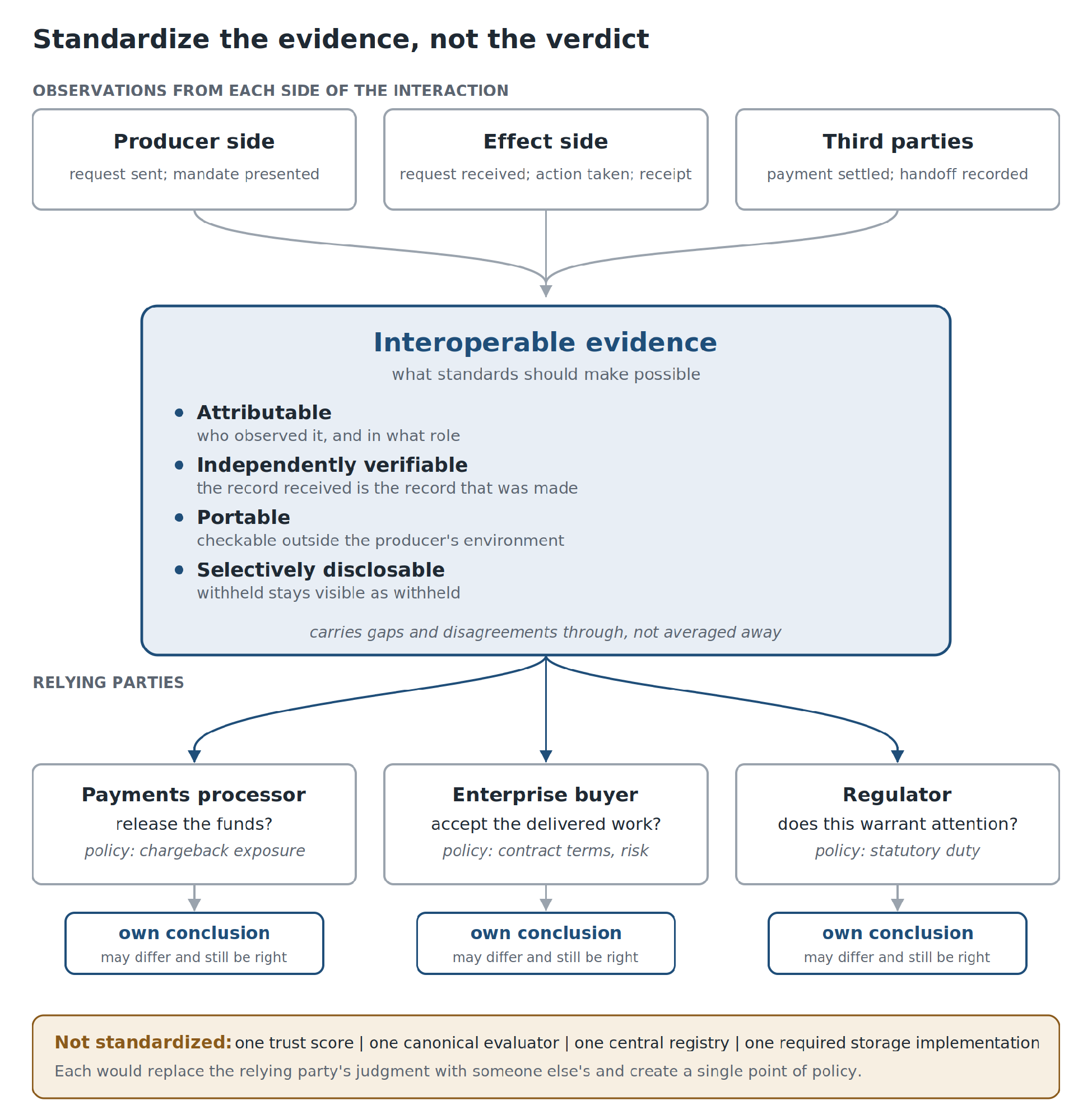
Figure 4. Same evidence, three legitimate decisions. Standards make observations attributable, verifiable, portable and selectively disclosable. Each relying party applies its own policy.
Standardize the evidence, not the verdict
None of this requires a new central authority. It requires that evidence produced in one place be readable and checkable in another, which is a standards problem with a fairly specific shape. It is the shape of the agent accountability composition draft at the IETF (draft-mih-sato-agent-accountability-composition): four legs, CAN, WHO, WHAT and AUDIT, each specified separately and verified independently, joined by one digest of the action, with the relying party's decision deliberately outside all four.
Standards should make it possible for a relying party to answer, about any evidence it receives: What is this about? Who produced or observed it, in what role? How is it linked to the interaction? How can its integrity be checked? What was disclosed and what withheld? And how can I use it without adopting the producer's trust policy as my own?
Standards should not attempt one universal trust score, one canonical evaluator whose verdict everyone must accept, one central registry all evidence must pass through, or one required storage or transparency implementation. Each of those replaces the relying party's judgment with someone else's and makes the ecosystem depend on a single point of policy.
That leaves a large question open. What infrastructure lets a relying party inspect evidence it did not have to trust the producer to reconstruct? It is a systems question and deserves its own treatment. The standards question comes first, and the test of whether it has been answered is the question a relying party can ask. Today it is usually "do you say this agent is trustworthy?" It should be "show me what I can check."
Standardize the evidence. Do not standardize the verdict.
Thanks to Junjie Bu, Sam Sharaf, Govindaraj Palanisamy, David Maitland and colleagues in the Agentic AI Foundation (LF AAIF) Working Group for helpful discussions and feedback on an earlier draft.